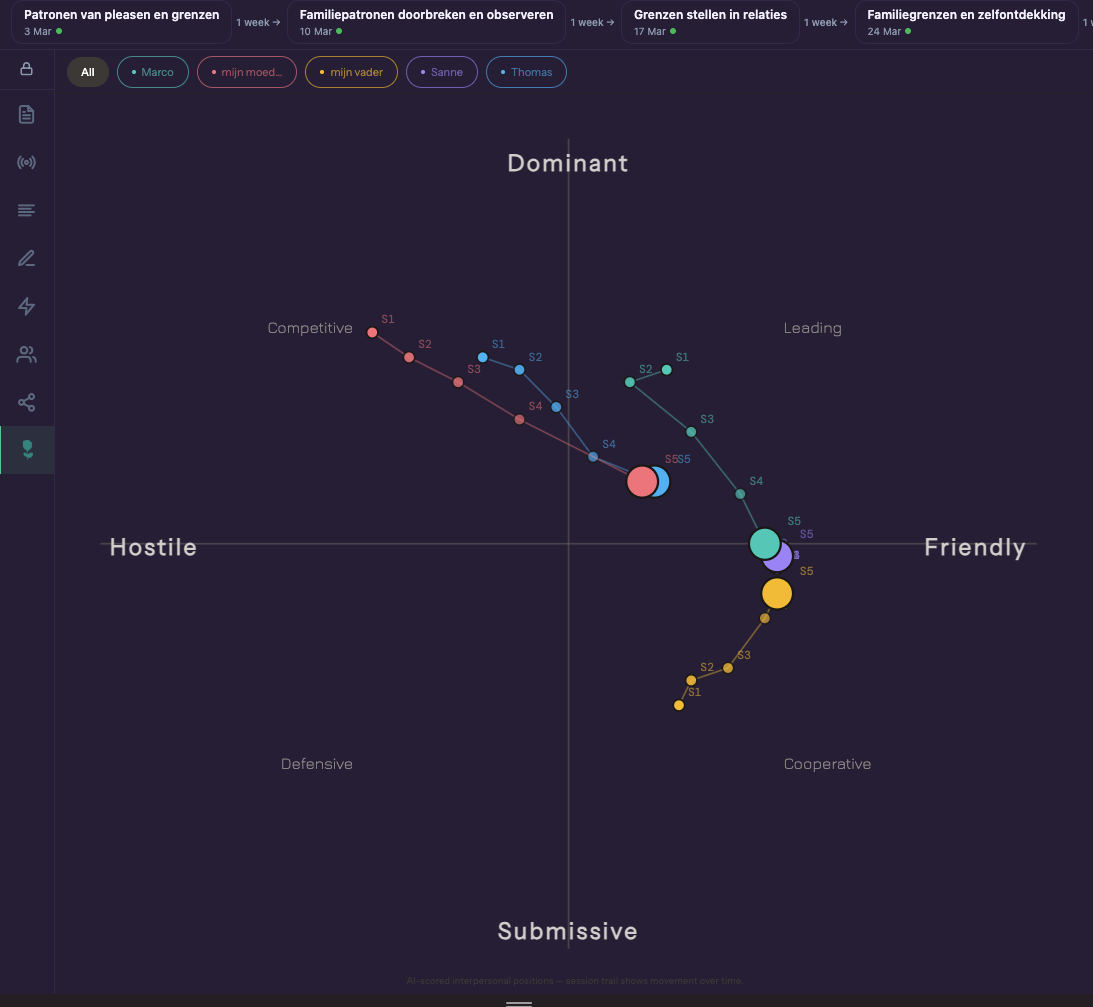
The Rose of Leary (Leary, 1957) describes how people relate to others in terms of dominance and affiliation. Freudche translates this model to every session — automatically, transparently, and clinically responsibly.
Relationship mapping · Not a diagnosis · Evidence-grounded
The interpersonal circumplex of Leary (1957) organises interpersonal behaviour along two axes: dominance (submissive ↔ dominant) and affiliation (hostile ↔ warm). Every behaviour in the therapeutic space — how a patient talks about parents, partners, colleagues — can be placed within this circular model of 8 octants.
From fully submissive (-1.0) to fully dominant (+1.0). Describes the power dynamic in a relationship as the patient experiences it.
From fully hostile (-1.0) to fully warm (+1.0). Describes the affective quality of the relationship.
Freudche scores each character who comes up on both axes on a scale of -1.0 to +1.0. Scores are displayed with a confidence level: HIGH, MEDIUM, or LOW. Only HIGH and MEDIUM confidence scores are shown — noise suppression by design.
Every score is backed by verbatim quotes from the session. You see exactly which patient statements led to the score — full transparency, no black box.
Freudche tracks how characters move across sessions. You see patterns over time on the circumplex — how a relationship evolves across weeks and months.
Groups like 'my parents' or 'my colleagues' are not scored. The Rose of Leary is a model for individual interpersonal dynamics — placing a group on the circumplex is clinically incoherent.
If a character does not come up in a session, Freudche does not score them as hostile or neutral. Absence from a session does not mean absence of warmth — the model is only applied where evidence is available.
The Rose of Leary in Freudche is an instrument for relationship mapping — it describes how the patient speaks about others, not who those others are. It is not a personality assessment of third parties. It is not a diagnostic instrument. It flags patterns in the therapeutic space that the therapist can incorporate into their clinical reasoning — not as a conclusion, but as a supplement.
The live demo shows the Rose of Leary in an anonymised sample session.
View in demoSharper sessions. Faster clarity. Your patients feel the difference — you see the evidence. Book a live demo and see it on real session work.
Book a live demoWe use privacy-friendly analytics cookies to understand how the site is used and make it better. Choose "Accept" to allow them, or keep only the cookies needed to run the site. Privacy Policy